
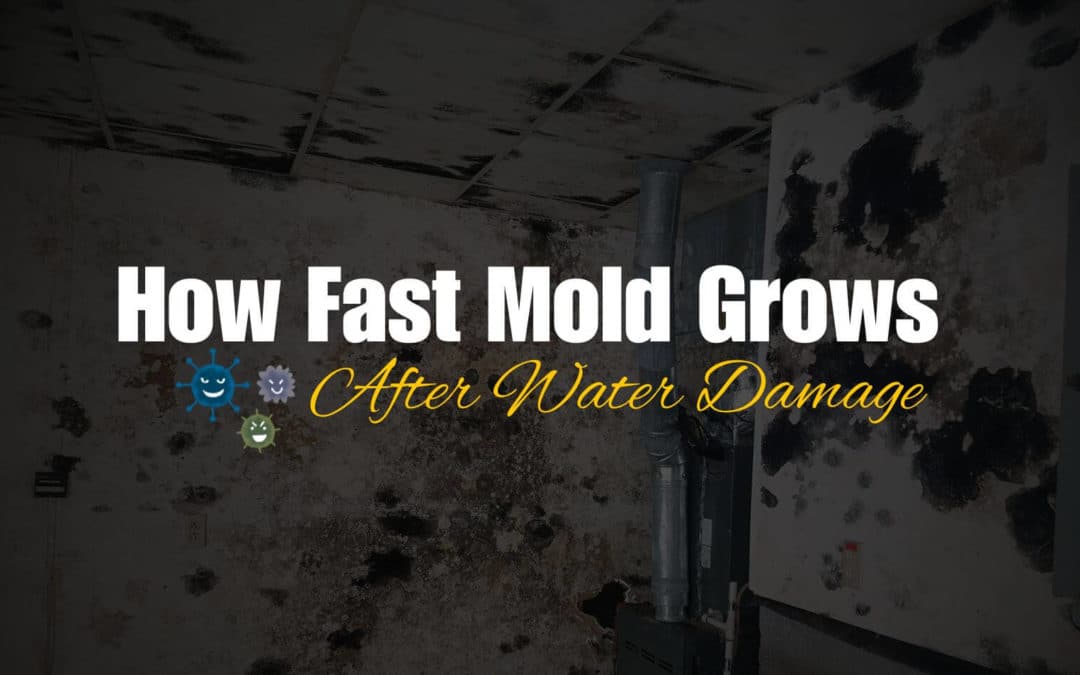
Water gets in. The clock is ticking. Act fast—mold grows quickly.
If your home just went through a flood, a burst pipe, or even a slow leak you didn’t notice, you’re probably wondering how long does mold take to grow. The honest answer? It can start in as little as 24 to 48 hours under the right conditions.
That’s not meant to scare you. It gives you the truth so you can act quickly and protect your home, health, and family.
We’ve seen what mold does when left unchecked. In this guide, we’ll show you how fast mold grows after water damage, what feeds it, and what you can do now to stop it. If you’ve had recent water damage, act now and contact us to assess and begin mold prevention immediately.
How Does Water Damage Lead to Mold Growth?
Mold is always present in the air around us as spores. Most of the time, these spores are harmless. But when moisture enters your home and cannot escape, spores land on wet surfaces and start to feed.
Does water grow mold? Not exactly, but water creates the perfect environment for mold. Mold needs three things to take hold:
- Moisture (from flooding, leaks, or high humidity)
- A food source (drywall, wood, carpet, insulation)
- Warmth (most indoor environments qualify)
Your home provides all three. That is why water damage and mold go hand in hand, and why acting quickly is important.
“In most water damage situations, active mold colonies begin to form within 24 to 72 hours. Key variables are temperature, humidity, and how long the material stays wet. Waiting longer makes remediation more difficult and costly.” |
How Long Does Mold Take to Grow After Water Damage?
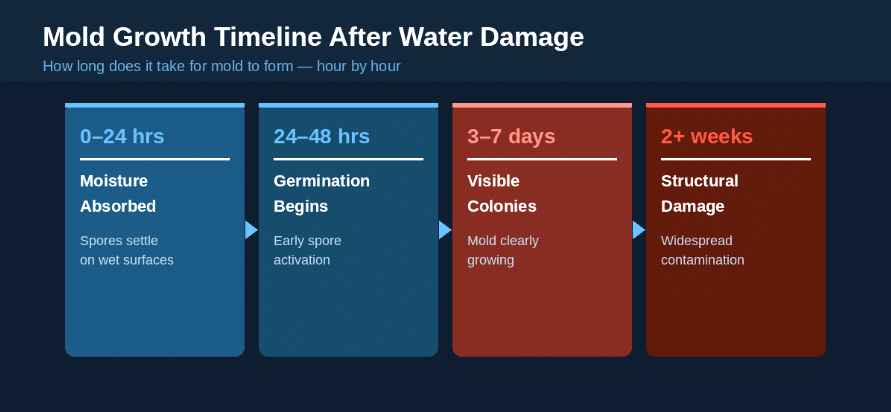
This is a frequently asked question. The following provides a clear and accurate timeline for mold growth after water damage.
0 to 24 Hours: Moisture Takes Hold
During the initial hours following water damage, building materials absorb moisture. Mold growth has not yet begun, but favorable conditions are developing. This period offers the optimal opportunity for intervention.
24 to 48 Hours: Mold Spores Begin to Germinate
How soon does mold grow after water damage? As early as 24 hours. Under warm, humid conditions, spores that landed on wet surfaces begin to germinate. You won’t see visible growth yet, but the process has started.
48 to 72 Hours: Early Colony Formation
By the second or third day, early colonies start forming. How fast does mold grow? At this stage, it’s growing rapidly and beginning to spread to adjacent surfaces. You may start to notice a musty smell.
1 to 2 Weeks: Visible Mold and Structural Damage
After a week, mold becomes clearly visible and penetrates deeper into materials. How fast does mold grow on drywall? Within 7 to 10 days on wet drywall, colonies can cover large areas and start to compromise the structure.
2+ Weeks: Widespread Contamination
At this stage, the rapid spread of mold becomes evident. Mold can move through wall cavities, spread to framing, and affect HVAC systems, distributing spores to additional rooms.
|
How Fast Does Black Mold Grow After Water Damage?
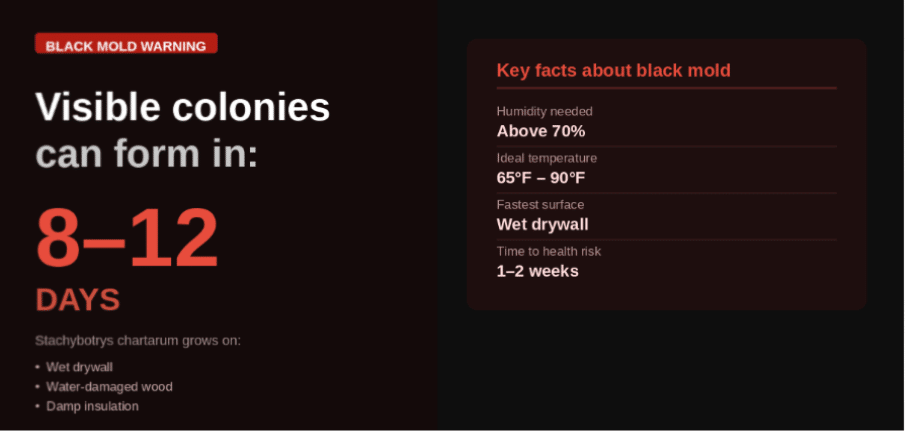
Black mold, technically known as Stachybotrys chartarum — is one of the most talked-about types of mold. People often ask: how long does it take for black mold to develop.
Black mold grows somewhat slower than other mold types, typically requiring 8 to 12 days of continuous moisture to form a visible colony. Its growth rate depends on several environmental factors:
- Temperature between 65°F and 90°F
- Sustained humidity above 70%
- Cellulose-rich surfaces like drywall, wood, or paper
Once black mold does form, how fast does black mold can double in size within days. Water damage and black mold are closely linked, especially in areas such as flooded basements, behind walls, and under flooring where moisture persists.
How long does it take black mold to grow enough to become a health hazard? As little as one to two weeks of continuous moisture on a suitable surface.
How Fast Does Mold Grow in Walls?
Wall cavities are one of the most dangerous places for mold to grow — because you can’t see it. How fast does mold grow in walls? Faster than you might think.
After a pipe burst or a flood, water soaks into your drywall and seeps behind it. The space between your drywall and framing is warm, dark, and poorly ventilated — ideal conditions for mold growth. Without direct sunlight or airflow, mold inside walls can spread aggressively.
How long does it take mold to grow on drywall? On wet drywall, early surface growth can appear in 24 to 48 hours. Full penetration into the paper backing and core can happen within 3 to 7 days.
Once mold develops within wall cavities, detection becomes challenging without a professional inspection. Therefore, promptly identifying water leaks is essential for early intervention.
How Do You Know If You Have a Water Leak Causing Mold?
Not all water damage is obvious. Sometimes a slow leak behind a wall or under flooring can feed mold growth for weeks before you notice. Here is how you can tell if you have a water leak that may be causing mold:
- Musty or earthy smell in a specific area of your home
- Discoloration or staining on walls, ceilings, or floors
- Peeling paint or bubbling wallpaper
- Warped or buckled flooring
- Unexplained spike in your water bill
- Cold or damp spots on walls
- Visible condensation on pipes or windows
If you notice any of these signs, do not wait to investigate. The longer moisture sits, the faster mold grows and the more damage it causes.
What to Do When Your House Floods
Knowing what to do when house floods can mean the difference between a manageable cleanup and a major mold remediation job. Time is everything.
Step 1: Stop the Source of Water
If safe, shut off your main water supply or stop the source of flooding immediately.
Step 2: Document the Damage
Take photos and videos of all affected areas before moving anything. You’ll need these for your insurance claim.
Step 3: Remove Standing Water
Use a wet-dry vacuum, mop, or pump to remove water quickly. Every hour counts.
Step 4: Start Drying Immediately
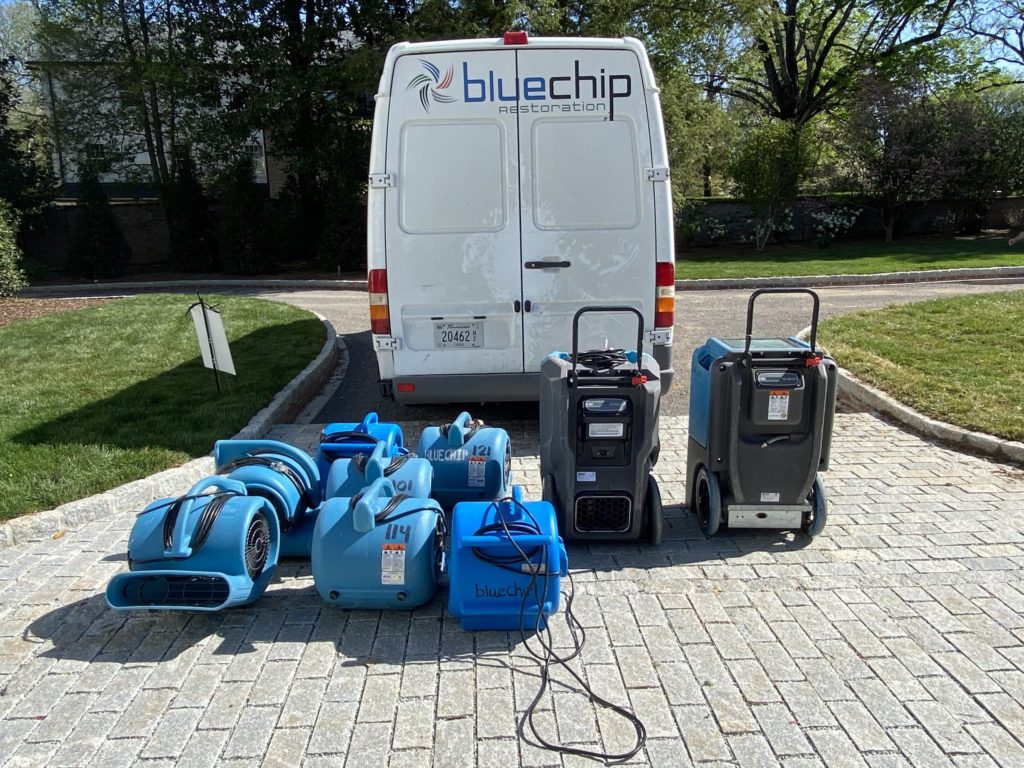
Open windows and doors if outdoor humidity is lower than indoors. Use fans and dehumidifiers to dry affected areas. Move wet furniture and rugs outside.
Step 5: Call a Professional Restoration Company
Even after you remove visible water, moisture remains in walls, subfloors, and insulation. A professional team uses moisture meters and thermal imaging to find hidden water before mold grows.
Blue Chip Restoration offers 24/7 emergency water damage response to help you act within that critical first window.
How to Prevent Mold After Water Damage
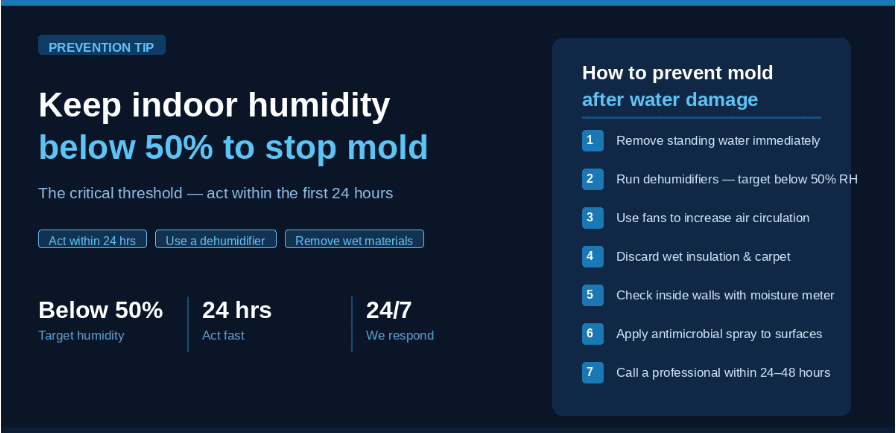
The good news: mold is preventable if you act within 24 to 48 hours. Here’s how to prevent mold after water damage:
- Extract standing water within the first hour if possible
- Use industrial-grade dehumidifiers to keep indoor humidity below 50%
- Remove and discard wet insulation, carpet, and porous materials
- Apply an antimicrobial spray to affected surfaces
- Increase air circulation with fans and open windows
- Check inside walls with a moisture meter before closing them back up
- Do not leave wet materials sealed off — this traps moisture and accelerates growth
The key to how to prevent water damage from turning into a mold problem is speed and thoroughness. Surface drying isn’t enough. You must address moisture in every layer of your home.
Signs of Mold Growth in Your Home After Water Damage
Even after you’ve cleaned up visible water, mold may still be forming. Here are signs to watch for in the days and weeks after water damage:
- A persistent musty or sour smell, even after the area seems dry
- New dark spots or staining on walls, ceilings, or baseboards
- Increased allergy symptoms — sneezing, coughing, watery eyes — among household members
- Discoloration on grout, caulk, or drywall
- Visible fuzzy or powdery growth in any color: black, green, gray, or white
Can mold be in water or grow on water-saturated surfaces? Yes. Can mold grow on water itself? Mold doesn’t grow in water directly, but any wet or damp surface — including damp wood, wet drywall, or water-saturated insulation — is a prime target.
When Should You Call a Professional for Mold Removal?
Not every mold situation requires DIY treatment. Here is when to call a certified mold remediation professional:
- Mold coverage is larger than 10 square feet
- Mold is growing inside walls, HVAC systems, or on structural materials
- Someone in your home has respiratory issues, allergies, or a compromised immune system
- You’ve had water damage for more than 48 hours without professional drying
- You can smell mold but can’t find the source
- Your home flooded from a contaminated source (sewage backup, river flooding)
Blue Chip Restoration offers certified mold inspection, testing, and remediation services. Our team uses industry-standard protocols to safely remove mold and restore your home.
|
Frequently Asked Questions (FAQ)
How long does mold take to grow after water damage?
Mold can start growing 24 to 48 hours after water damage in warm, humid conditions. Visible colonies often appear within 3 to 7 days. Removing moisture quickly lowers your risk.
How fast does black mold grow?
Black mold (Stachybotrys chartarum) generally takes 8 to 12 days to form visible colonies. It grows aggressively once established, especially on cellulose materials like drywall and wood. How quickly does black mold grow depends heavily on how long moisture persists.
How long does it take for mold to form on drywall?
Mold can begin forming on wet drywall within 24 to 48 hours. Drywall is porous and contains paper, a food source for mold, so it develops growth quickly. Mold can penetrate the core within a week.
Does mold grow in water?
Mold doesn’t grow in water itself, but it thrives on any surface that has been wet or that holds moisture. So while mold doesn’t live in water, can water grow mold on your walls, floors, and ceiling? Absolutely — any wet building material is at risk.
How do you know if you have a water leak leading to mold?
Common signs include a musty smell, discolored walls or ceilings, peeling paint, warped flooring, or unexplained spikes in your water bill. If you smell mold but cannot see it, it may be growing inside walls where a hidden leak has gone unnoticed.
How fast can mold spread through a home?
How fast mold spreads depends on the size of the moisture source and the types of materials affected. In a home with high humidity and multiple wet surfaces, mold can reach adjacent rooms within 1 to 2 weeks, especially through HVAC systems or shared wall cavities.
What should I do immediately after water damage to prevent mold?
Remove standing water immediately, start drying with fans and dehumidifiers, remove wet porous materials, and call a professional restoration company within 24 hours if possible. The faster you respond, the better your chances of preventing mold.
How long does it take for mold to become a health hazard?
Mold can trigger respiratory symptoms, allergic reactions, and other health effects within days of significant growth. People with asthma, allergies, or compromised immune systems are most at risk. Early action is the best protection.
Can I remove mold after water damage myself?
Small mold patches under 10 square feet on non-porous surfaces can be addressed with commercial products. For mold inside walls, on structural materials, or covering more than 10 square feet, professional remediation is strongly recommended to ensure safe, complete removal.
Why choose Blue Chip Restoration for water damage and mold remediation?
Blue Chip Restoration is a certified water damage and mold remediation company with hands-on experience in emergency response, professional drying, and complete mold removal. We respond 24/7 and use advanced moisture detection equipment to find and eliminate mold at its source.
About Blue Chip Restoration
Blue Chip Restoration is a trusted, certified restoration company specializing in water damage mitigation, mold remediation, and emergency response services. With years of hands-on experience and a commitment to restoring homes safely and thoroughly, we are here when you need us most.
Available 24/7 | Certified Technicians | Advanced Drying & Mold Detection Equipment