
A humid crawl space in Middle Tennessee usually means the relative humidity under your home has climbed above 60 percent, the threshold where mold spores start to activate on wood framing and insulation. In Nashville summers, with average humidity sitting near 65 percent and heat index days pushing higher, an unsealed or unvented crawl space can cross that line by mid-morning and stay there until fall.
If you’ve noticed a musty smell coming up through your floor vents, or your hardwood floors feel slightly soft near exterior walls, your crawl space is probably telling you something before your nose does.
What Counts as Too Humid Under Your House
A healthy crawl space stays below 55 percent relative humidity. Between 55 and 60 percent, moisture starts collecting on cool surfaces like ductwork and floor joists. Above 60 percent, you’re in mold-growth territory, and above 70 percent, active fungal growth can appear on exposed wood within 24 to 48 hours under the right temperature conditions.
Middle Tennessee’s climate makes this threshold easy to cross. Warm, moisture-laden air from outside enters a vented crawl space, hits the cooler soil and framing underneath the house, and condenses. This is the same principle as a cold glass of tea sweating on a summer porch, except it’s happening continuously, in the dark, against your subfloor.
Why Nashville and Middle Tennessee Summers Are Especially Hard on Crawl Spaces
Middle Tennessee sits in a humid subtropical zone. Nashville alone receives around 47 to 50 inches of rainfall a year, well above the national average, and summer humidity regularly sits in the 60 to 75 percent range. Combine that with clay-heavy soil common across Davidson, Williamson, and Wilson counties, and you get ground moisture that doesn’t drain quickly after a storm.
Older housing stock in neighborhoods like East Nashville, Germantown, and parts of Franklin’s historic core often has traditional vented crawl spaces, a design standard decades ago that modern building science has largely moved away from. Newer construction in fast-growing areas like Mt. Juliet and Providence isn’t immune either. New subdivisions built on regraded lots can have poor drainage away from the foundation until landscaping matures, which pushes surface water toward the crawl space perimeter during Middle Tennessee’s heavy spring and summer storms.
Local Pain Points Homeowners Are Actually Dealing With
Across Nashville, Franklin, Mt. Juliet, Hermitage, and the wider Williamson County area, the complaints we hear are remarkably consistent:
- A musty odor that gets worse in July and August and fades in cooler months
- Wood floors that feel slightly spongy near exterior walls
- Visible condensation on HVAC ductwork running through the crawl space
- A spike in seasonal allergy symptoms inside the house
- Insulation sagging or falling away from the subfloor
- A home inspection report ahead of a sale flagging “elevated moisture” or “conducive conditions for wood decay fungi”
That last one comes up a lot in Williamson County, where a hot real estate market means buyers’ inspectors are looking closely, and a crawl space moisture flag can stall or reprice a closing.
The Mold Connection: How Fast This Escalates
Crawl space moisture and mold growth are not two separate problems. They are one problem at two different stages. Mold spores are present in essentially every crawl space. What determines whether they stay dormant or start colonizing wood is moisture, temperature, and time.
In a Middle Tennessee summer, with crawl space humidity often sitting well above 60 percent for weeks at a time, that window from “damp” to “visible mold growth” can be as short as a few days on exposed wood surfaces. Once mold establishes on floor joists or subflooring, it doesn’t stay contained to the crawl space. Air pressure differences between your crawl space and living areas, a phenomenon known as the stack effect, can pull mold spores and musty air up into the home through gaps around plumbing penetrations, HVAC returns, and subfloor seams.
This is why a mold remediation call in July is very often traced back to a crawl space humidity problem that started building in May.
Warning Signs You Can Check This Week
You don’t need a moisture meter to catch most of these:
- Open the crawl space access door. If you smell mildew or “basement smell” immediately, humidity is already elevated
- Look at any exposed metal, like HVAC straps or nails. Surface rust or beading water is a strong signal
- Check insulation batts for sagging, staining, or a heavier-than-normal feel
- Look for white, powdery mineral deposits (efflorescence) on foundation walls, a sign moisture is moving through the concrete
- Note whether floor vents in the room above feel unusually cool or damp to the touch during summer
If two or more of these are present, it’s worth having a professional confirm relative humidity levels with a hygrometer rather than guessing.
What Actually Works: Dehumidification, Encapsulation, or Both
There are two core strategies for controlling crawl space humidity, and they solve different parts of the problem.
Mechanical dehumidification removes moisture from the air actively, using a dehumidifier sized for the crawl space’s square footage. It’s effective but treats the symptom. If moisture keeps entering through vents, soil, or foundation gaps, the dehumidifier runs constantly and works harder than it should.
Crawl space encapsulation addresses the source. It involves sealing vents, installing a heavy-duty vapor barrier across the soil floor and up the foundation walls, and sealing gaps and penetrations. This stops most outside moisture and ground moisture from entering in the first place.
In Middle Tennessee’s climate, most crawl spaces need both. Encapsulation without dehumidification still traps residual moisture inside a sealed space. Dehumidification without encapsulation means fighting a constant, unnecessary moisture load.
Our Crawl Space Moisture Control Process
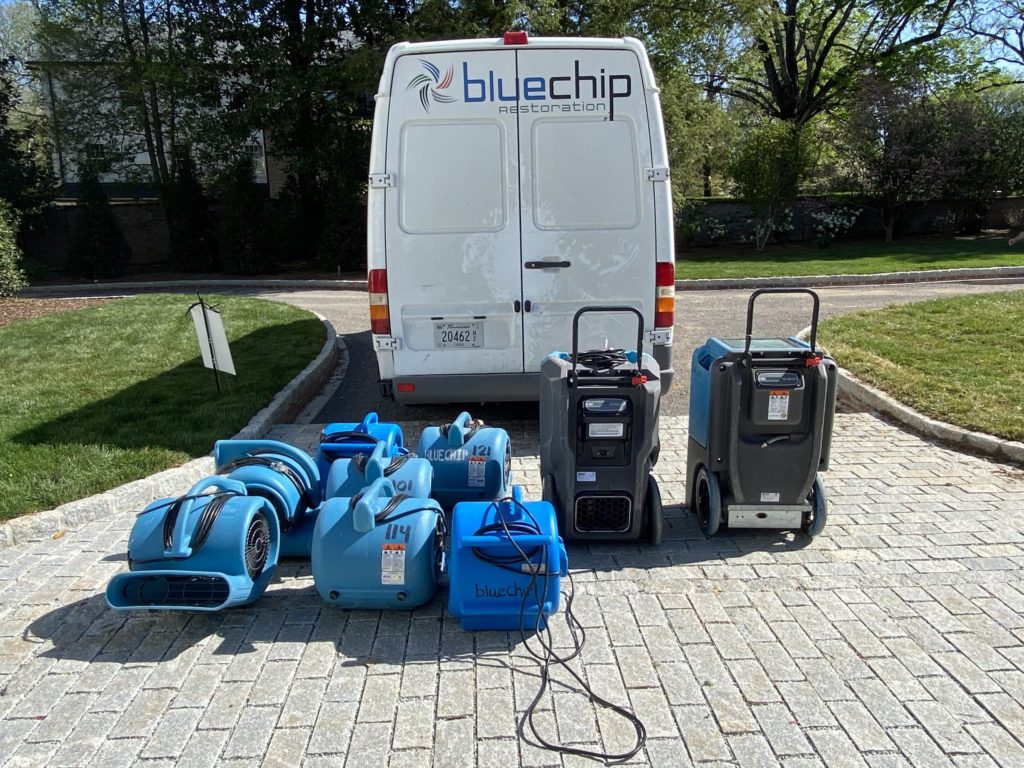
Blue Chip Restoration approaches crawl space moisture the same way we approach any restoration problem: diagnose first, then treat the cause, not just the symptom.
- Inspect. We measure relative humidity, check for existing mold growth, and assess vapor barrier condition, drainage, and vent placement.
- Contain. If active mold is present, we isolate the crawl space from the rest of the home before any remediation work begins, following IICRC S520 protocol.
- Remediate existing mold, if present. Affected materials are treated or removed and replaced as needed.
- Seal and encapsulate. Vents are closed, a vapor barrier is installed across the floor and walls, and gaps are sealed.
- Dehumidify. A properly sized dehumidification system is installed to maintain humidity below the 55 percent threshold year-round.
- Verify and certify. We re-test humidity levels and document the results before closing out the job.
Because Blue Chip is a licensed general contractor as well as an IICRC-certified restoration firm, we handle any structural repair, from replacing compromised subflooring to reinforcing joists, without bringing in a separate subcontractor. That’s a meaningful difference from franchise competitors who typically remediate and then hand the rebuild off to a third party.
Why DIY Fixes Usually Fall Short Here
A box-store dehumidifier and a plastic sheet from the hardware store can help temporarily, but they miss the details that matter in this climate. Vapor barriers need proper seaming and wall attachment to actually stop moisture migration. Dehumidifiers need correct sizing and a drainage line, not a bucket someone forgets to empty. And any existing mold growth needs to be addressed before sealing the space, or you’ve just built a humid, dark, sealed environment for it to keep growing in.
Crawl Space Moisture Control Methods Compared
| Method | What It Solves | Limitation | Best For |
|---|---|---|---|
| Dehumidifier only | Removes existing moisture from air | Doesn’t stop new moisture entering | Short-term or already-encapsulated spaces |
| Vapor barrier only | Blocks ground moisture | Doesn’t address vent-driven humid air | Dry soil, low vent exposure |
| Full encapsulation | Blocks ground and vent-driven moisture | Higher upfront cost | Most Middle Tennessee homes |
| Encapsulation + dehumidification | Blocks moisture source and removes residual humidity | Highest upfront investment | Long-term protection in humid climates |
Trust, Standards, and Safety
Every mold-related aspect of our crawl space work follows IICRC S520 protocol, the industry standard for mold remediation. Our technicians are IICRC certified, and Blue Chip carries a BBB A+ accreditation. We’ve been recognized in Nashville Scene’s “Best Of” awards in 2021 and 2022, along with three consecutive Expertise Awards.
We don’t fabricate reviews or ratings, and we won’t tell you that you need encapsulation if a dehumidifier alone will solve your specific situation. Every crawl space assessment includes a straightforward explanation of what we found and why we’re recommending a given fix.
FAQ Section
What humidity level is safe for a crawl space? Relative humidity below 55 percent is considered safe. Above 60 percent, conditions become favorable for mold growth on wood framing and insulation.
How do I know if my crawl space has a moisture problem? Common signs include a musty odor near floor vents, condensation on ductwork, sagging insulation, and soft or spongy flooring near exterior walls.
Does encapsulation alone stop crawl space humidity in Middle Tennessee? Usually not on its own. Encapsulation blocks moisture from entering, but most Middle Tennessee crawl spaces also need a dehumidifier to remove residual humidity and maintain safe levels year-round.
How fast can mold grow in a humid crawl space? Under summer conditions with humidity above 60 to 70 percent, mold can begin colonizing exposed wood surfaces within 24 to 48 hours.
Can crawl space mold affect air quality inside my home? Yes. Pressure differences between the crawl space and living areas can pull musty air and mold spores upward through subfloor gaps, plumbing penetrations, and HVAC returns.
Is crawl space moisture covered by homeowners insurance? Coverage depends on the cause. Sudden events like a burst pipe are often covered, while gradual humidity buildup typically isn’t. We can help document the cause during inspection to support any claim conversation.
How much does crawl space encapsulation cost in Nashville? Cost varies based on square footage, existing moisture damage, and whether structural repairs are needed. Blue Chip provides a free, no-obligation inspection and written estimate before any work begins.